Protests took place in Tel Aviv, Jerusalem, Haifa, and Beersheba, as a survey found broad but uneven support among Jewish Israelis for Operation Roaring Lion.
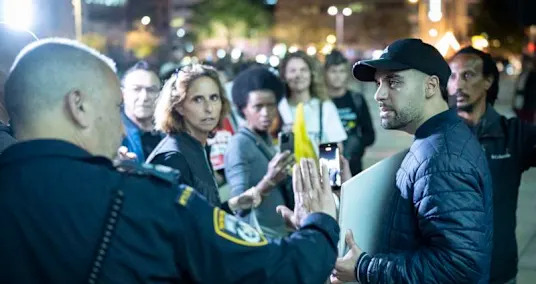
Israel Police arrested 21 anti-war protesters Saturday night as demonstrations against the conflict with Iran expanded in multiple cities despite restrictions on public gatherings.
Protests took place in Tel Aviv, Jerusalem, Haifa, and Beersheba, with hundreds of participants reported in Tel Aviv and Jerusalem and about 100 in Haifa, marking the largest turnout since weekly demonstrations began. Authorities said 13 people were arrested in Tel Aviv and eight in Haifa.
Police said the gatherings were not approved under Home Front Command regulations that ban events with more than 50 people. Officials said the increase in turnout followed calls by groups opposing the government to protest despite the restrictions.
“During a situation assessment that took place at the scene with a Home Front Command representative… it was clarified that there was a real risk to human life and accordingly, Yarkon [precinct] police commander Tzachi Sharabi ordered the gathering to be dispersed,” police said.
Hadash-Ta’al chairman Ayman Odeh, an Arab lawmaker involved in the protests, criticized the police response, calling officers fascists “in the service of the government” and saying they were afraid of “the heroic citizens who went out, despite everything, to make their voice heard.”

Survey shows broad, uneven support for war
The demonstrations come as a March 2026 survey by the Israel Democracy Institute found broad but uneven support among Jewish Israelis for Operation Roaring Lion. Support was strongest on the Right at 87% and about half on the Left.
The survey also found that Jewish and Arab respondents largely agreed that Iran’s resilience has been stronger than expected. Most Jewish respondents said Israeli society could sustain the campaign for up to one month, while 28% said as long as needed. Arab respondents were less optimistic about how long the public could endure the conflict.
A majority of Jewish respondents said Prime Minister Benjamin Netanyahu’s decision was driven by security considerations, while most Arab respondents viewed it as political.
NEUESTE BEITRÄGE
- 1
 Rediscovering Euphoria: Individual Accounts of Conquering Despondency22.09.2023
 - 2Eight Muslim nations condemn Israel's 'dangerous' new death penalty law02.04.2026
- 3The Delight of Camper Vans: Choosing the One That Meets Your Requirements05.06.2024
- 4Artemis II crew take new photo of far side of the moon05.04.2026
- 5Infants will no longer receive hepatitis B vaccine at birth, CDC announces05.12.2025




Ähnliche Artikel
- NASA's Artemis 2 moon launch may be visible from Florida and southern Georgia today. Here's when to look01.04.2026
- Grasping the Basics of Business Land Regulation30.06.2023
- Spain breaks jobs record with 22 million Social Security contributors06.04.2026
- Benedict Cumberbatch takes on something even Sherlock can’t solve: male grief28.11.2025
- Cameroon says Russia has confirmed 16 Cameroonian soldiers died in Ukraine07.04.2026
- Wegmans recalls mixed nuts over salmonella contamination fears08.12.2025
- The Minimized Passage Horse: Reconsidering a Symbol for the Cutting edge Period08.11.2023
- The Rhythms of the Street: Shipping's Tune in the Economy's Symphony07.11.2023
- Beating Wellbeing Difficulties: Individual Victories in Health22.09.2023
- Fundamental Home Exercise center Hardware: Amplify Your Exercises06.06.2024