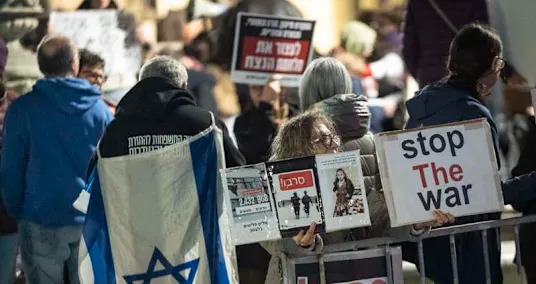
Demonstrators carried signs reading “We must stop” and “Bibi will kill us all,” while about 200 people gathered at Horev Junction in Haifa.
Anti-war demonstrations were held across Israel on Saturday evening, with protesters gathering in Tel Aviv, Haifa, Jerusalem, and Kfar Saba despite strict wartime restrictions on public assembly.
Demonstrators carried signs reading “We must stop” and “Bibi will kill us all,” while about 200 people gathered at Horev Junction in Haifa.
Earlier on Saturday, the Home Front Command granted an exceptional permit for a protest of up to 150 people at Habima Square in Tel Aviv, after state authorities told the High Court of Justice that demonstrations would be allowed only in a limited format and under tight attendance caps.
The Association for Civil Rights in Israel sought an urgent hearing, arguing that the restrictions harm the right to protest.

Security restrictions and court dispute
One IDF officer said the Home Front Command examined each requested protest site individually on operational, professional, and security grounds, including proximity to protected spaces. As a result, authorities did not approve a large gathering at Habima Square and instead allowed only 50 to 150 participants near a shelter.
The officer said the military declined to provide further details on all of its security considerations, but offered to present them to the court in a closed session.
“We are acting professionally and objectively. There is no political consideration here or any other consideration,” he said.
The requests covered several locations, including Habima Square in Tel Aviv, Horev Center in Haifa, Paris Square in Jerusalem, and Weizmann Street in Kfar Saba. In Tel Aviv, the state told the Supreme Court that the protest could proceed in two separate groups of up to 75 people each, for a total of 150 participants.
Protest groups push back
Police and the Home Front Command said the limits stemmed from operational and security concerns, against the backdrop of fears of missile fire and broader wartime restrictions on gatherings.
Civil rights lawyers, however, argued in court that earlier judicial remarks on the importance of political free expression during wartime had not been meaningfully implemented.
The dispute followed a tense High Court hearing on Friday, during which Supreme Court President Isaac Amit sharply criticized the state’s position.
The judges stressed that the right to protest does not disappear during war and said police should propose a framework that would allow demonstrations to proceed.
NEUESTE BEITRÄGE
- 1
 12 Once-In-A-Lifetime Travel Experiences To Add to Your Bucket List01.04.2026
 - 2Why boosting production of Venezuela's 'very dense, very sloppy' oil could harm the environment09.01.2026
- 3Far-right German youth group delegates seek deportations, remigration29.11.2025
- 4Etymological Investigation Disclosed: A Survey of \Dominating New Tongues\ Language Learning Application10.08.2023
- 5Activist vessel collides with krill trawler in Antarctic confrontation01.04.2026




Ähnliche Artikel
- Timothy Busfield turns himself in to face child sexual abuse charges in New Mexico13.01.2026
- Artemis II astronauts channel Apollo 8 with a striking Earthset photo07.04.2026
- Figure out How to Track and Anticipate Future Cd Rates19.10.2023
- NMG signs new graphite supply deal with Canadian Government27.03.2026
- Putin, Netanyahu discuss Middle East in phone call, Kremlin says15.11.2025
- Instructions to Comprehend and Use Open Record Extra Offers19.10.2023
- East Germany Somehow Built a Real Sports Car and It Was Wild29.03.2026
- China Just Got A Lot Closer To Its First-Ever Manned Moon Landing28.03.2026
- A definitive Manual for Internet Mastering and Expertise Improvement01.01.1
- 1st human missions to Mars should hunt for signs of life, report says09.12.2025