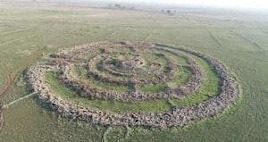

The newly discovered sites all share a similar design: large circular structures, between approximately 50 to 250 meters in diameter, built with stones taken from local basalt fields.
The stone circles of Rujm el-Hiri, nicknamed “Israel’s Stonehenge” or “Gilgal Refaim,” are not the only ones of its kind, according to a new study by Ben-Gurion University of the Negev (BGU) researchers.
By using advanced satellite imagery and remote sensing technology to survey areas previously inaccessible, BGU researchers have identified at least 28 other sites within 25 kilometers of Rujm el-Hiri that were not previously known.
The findings, recently published journal PLOS One, suggest that Rujm el-Hiri was not a singular, isolated monument, but rather an “elaborate example of a widespread architectural tradition integrated into the social and economic systems of the proto-historic Levant.”
Rujm el-Hiri was first discovered in the Golan Heights in 1968, and has been dated to approximately 3,500 and 6,500 years ago. It is made of a central cairn encircled by multiple concentric basalt stone rings, spanning for over 150 meters in diameter.
Satellite imagery revealed that the newly discovered sites share a similar design: large circular structures, between approximately 50 to 250 meters in diameter, built with stones taken from local basalt fieldstones.

Site part of a broader social, economic system
The discovered structures contain circular walls and internal partitions, often located near seasonal water sources and integrated into agricultural land use, revealing how ancient populations managed their resources and moved across the area.
Further, researchers believe the stone circles may have been multi-purpose, serving as ritual gathering places, territorial markers, or assembly sites for ancient herding communities, adding to earlier theories of Rujm el-Hiri being a burial site or astronomical observatory.
According to Dr. Michal Birkenfeld of BGU’s Department of Archaeology, the circles “invite a reinterpretation of significant proto-historic monuments in the region, recognizing them as integral parts of broader social and economic systems.”
"Our analysis may have implications for previous interpretations of Rujm el-Hiri's function," she concluded. "While traditional archaeological methods remain essential, this landscape-based perspective allows us to reach a fuller understanding of these monuments within our shared human past."
NEUESTE BEITRÄGE
- 1
 Antivirus Programming for Exhaustive Security06.06.2024
 - 2Vote In favor of Your #1 Electric Vehicles01.01.1
- 3How did Ariana Grande get her Glinda voice? I’m the man behind the magic.19.11.2025
- 4How to Build a Yard That Helps Monarchs During Spring Migration04.04.2026
- 5'An incredible privilege and responsibility': Artemis 2's Christina Koch is ready to become the 1st woman to fly around the moon29.03.2026




Ähnliche Artikel
- Moving Wedding Objections for Paramount Functions05.06.2024
- Violence 'never part' of break-in plan, court told04.12.2025
- Chemical leak in Oklahoma forces evacuations and leaves many ill13.11.2025
- 'No middle ground' for tackling antisemitism after Bondi Beach mass shooting, deputy FM Haskel says14.12.2025
- MacArthur Foundation awards $100M to outbreak surveillance network, a boost amid global health cuts18.11.2025
- This St Nick Truly Can Advise How To Drink And Hack Your Headache04.12.2015
- Kenmore East reacts to their best overall delegation award at WNY Model United Nations General Assembly competition31.03.2026
- 6 Arranging Administrations to Change Your Open air Space06.06.2024
- Sydney Sweeney's American Eagle campaign and Kendrick Lamar's Super Bowl performance were among the 10 biggest pop-culture moments of 202529.12.2025
- ‘We are the alternative’: Anti-Hamas Gaza militia tells BBC group is receiving international support21.11.2025