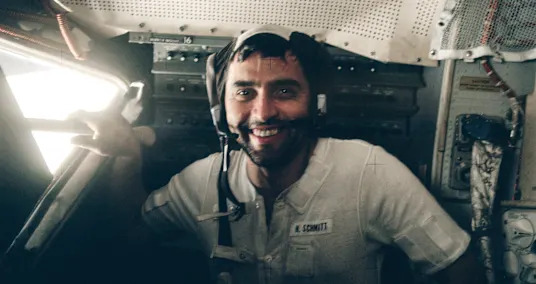
If anyone can offer advice to the four NASA astronauts slated to launch Wednesday on a trip around the moon, it’s Harrison Schmitt.
Schmitt, 90, left his bootprints on the lunar surface in 1972, as part of Apollo 17 — the final mission in the program, which was the last time humans traveled to the moon.
NASA’s Artemis II mission, which is scheduled to lift off as early as 6:24 p.m. Wednesday, aims to kick-start a new era of lunar exploration. The crew plans to circle the moon as a step toward a lunar landing in 2028 (similar to the way Apollo 8's flight around the moon paved the way for Apollo 11).
Schmitt expects the Artemis II astronauts to see some of the same otherworldly sights he did more than a half century ago.
“Every day, every hour, every minute, is a new experience,” Schmitt said in an interview with NBC News.

As for what he’d tell the Artemis II crew: “Make sure that you’ve got your training down pat. Be ready for anything unexpected, but have a great time. Enjoy it.”
Much has changed since Apollo 17. Schmitt and his fellow crew members were part of a space race against the Soviet Union. Today, NASA is competing with China, which hopes to land its own astronauts on the moon in 2030.
The Apollo 17 astronauts spent nearly 13 days in space — more than three of those on the lunar surface. They notched the highest total distance traveled on the moon, driving a lunar rover a total of about 19 miles. They also gathered more geology samples than any other moon mission, bringing 243 pounds back to Earth.

Schmitt said he won’t forget entering lunar orbit in the dark, on the far side of the moon that faces away from Earth.
“We were landing on the east side of the moon, and the sun was just barely coming up,” Schmitt said. “Going into the dark of the moon was really something, because one of the things that you notice right away is the moon is illuminated by Earth light. There’s a bluish tint to the light.”

The Artemis II astronauts will get better glimpses of the moon’s far side than Apollo crews did.
“It turns out there’s about 60% of the far side, I think, that has never been seen by human eyes because of the lighting conditions,” Reid Wiseman, commander of the Artemis II mission, said in a media briefing on Friday. “Apollo always wanted that light on the front side of the moon for their landing and launch capability … We’ve seen it in satellite photos, but humans have never, ever seen that before. That’s cool.”
Apollo 17’s conclusion represented, for decades, the end of U.S. ambitions to maintain a human presence on the moon. NASA’s budget shrank in the 1970s, additional Apollo missions were canceled and the U.S. prioritized work on space stations.

Unlike the Apollo program, NASA’s long-term goal with Artemis goes beyond brief visits to the moon. The space agency hopes to build a lunar base to facilitate long-term stays, then eventually use that base as a stepping stone to Mars.
“It wouldn’t surprise me in somebody else’s lifetime to see people there for months and years and actually have an actual settlement on the moon,” Schmitt said. “Mars is attainable, and I think we will keep going.”
Why is he so sure? “We’re humans, that’s what we’ve always done,” Schmitt said.
“From the time that the human race began in Africa to the present, it’s always expanded. It’s part of our being, our psychology,” he said.

When the Apollo 17 crew departed the moon, commander Gene Cernan said: “We leave as we came, and, God willing, we shall return, with peace and hope for all mankind.”
If all goes to plan, Artemis II will be a major milestone in the effort to make that return. On the sixth day of their mission, the crew is expected to come within about 6,000 miles of the lunar surface. Their path around the moon could take them a greater distance from Earth than anyone has gone before.
“These kinds of flights for the country are extraordinarily important,” Schmitt said. “China is clearly interested in dominating space as they’re interested in dominating terrestrial activities. And so it’s a national effort, and needs to be done well and right.”
This article was originally published on NBCNews.com
NEUESTE BEITRÄGE
- 1
 Artemis will take Americans to the moon for the 1st time since 1972. Why has it been so hard to go back?31.03.2026
 - 2Washington state experiences historic flooding as Skagit River hits record high level. See flooding maps, highway closures and forecasts.12.12.2025
- 3Artemis II astronauts arrive in Florida to prepare for launch to the moon27.03.2026
- 4NASA begins fueling rocket to launch astronauts on the first lunar trip in half a century01.04.2026
- 5IDF: Staying in West Bank refugee camps will quell lone-wolf terror04.01.2026


Ähnliche Artikel
- Flight cancellations: Full list of 40 airports hit by FAA cuts amid government shutdown07.11.2025
- Grasping the Elements of Medical caretaker Pay rates: Factors That Shape Your Pay17.10.2023
- The Significance of Health Projects in Senior Protection.19.10.2023
- Flu season is ramping up, and some experts are "pretty worried"23.12.2025
- Chris Noth responds to backlash after seemingly shading 'Sex and the City' costar Sarah Jessica Parker: 'It is not news'14.01.2026
- Unsold Rams May Be Less expensive Than You Suspect06.11.2023
- Lift Your Style: Famous Hairdos for Ladies06.06.2024
- How a rare drug made from scientists' blood saves babies from botulism09.12.2025
- The Fragrant Small Tree Birds & Pollinators Love With Stunning Flowers In Summer28.03.2026
- A definitive Manual for the Over-Ear Earphones05.06.2024